To the RIBA / Observer debate on tall buildings, where we hear from Rowan Moore and Simon Jenkins (two journalists), who think tall buildings are a blight, and from Julia Barfield and Peter Rees (two professionals), who don't.
For such a subject that is so emotive - at least in architectural and planning circles - it was a surprisingly even-tempered and consensual occasion, with everyone, panel and audience, lay and professional, basically agreeing that the answer to the question 'are tall buildings blighting our skyline?' is that the ugly ones are and the beautiful ones aren't; and that it would be nice if there was a bit more planning to counter the opportunism of the promoters of projects.
Moore thought that the London Plan sets out the right policies and quality standards, but that many project that have been built or approved fail to meet these policies and standards. Rees made the slightly odd assertion that you shouldn't build high unless it is necessary to do so (why not?), but that it is necessary in the City because there is no spare land, so you should make sure you do it well. Barfield pointed out that you can't blight a skyline with beautiful buildings, and reminded us that the best tall buildings are listed. Jenkins' view was that the argument is about planning, not architecture, and that the 'pass was sold' long ago.
For Jenkins, the problem is that there is no one to dictate what the skyline should be like. Your blogger pointed out from the floor that dictating is best done by dictators - my thinking being that lack of consensus is part of the problem. Is the fact that some people don't want these things - almost certainly a minority - enough to stop those who want to build them, who are doing so because they are providing offices and flats that are wanted? And in spite of the theoretical consensus about stopping the ugly ones, there is less agreement than you might think about which those are.
This was a room full of people who cared about the subject; most don't. The self-selecting audience - with those admitting to being architects, in a show of hands prompted by Simon Jenkins who thought he was in the lions' den, forming only about a quarter of those present - answered 'no' by a clear majority to the proposition.
The most chilling observation of the evening, almost certainly accurate, came from Rowan Moore, who suggested that the planning car crash that is the 'emerging Vauxhall cluster' of towers is a result of a development zone being on the border of two local authorities (Lambeth and Wandsworth), the politicians of each of which are prepared to let rip, in development terms, because there are few voters nearby who care, and other areas of the boroughs will benefit from what Jenkins referred to as the 'bribes' (Section 106 etc.) that smooth the path of these things.
Showing posts with label tall buildings. Show all posts
Showing posts with label tall buildings. Show all posts
Friday, 19 April 2013

Wednesday, 14 November 2012
New towers of London: Cheesegrater, Walkie Talkie and the rest
The view towards the City of London from Waterloo Bridge is one of the best in London, which is one reason why it appears in the header to this blog*.
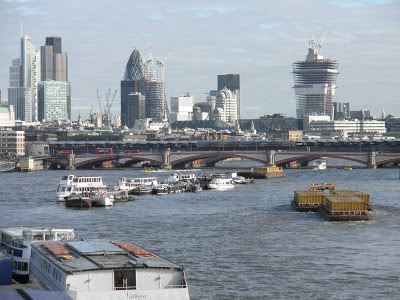
The more recent photo above shows the present state of the City's skyline, with cranes as prominent as buildings, most notably on the sites of two of the City's new towers: Rogers Stirk Harbour's 'Cheesegrater' (next to Foster's Gherkin) and Viñoly's 'Walkie Talkie' (on the right), the frame of which now begins to show us the shape of building we will be getting (in case we hadn't quite believed it).
If you've spent your adult life involved in putting up buildings, the sight of this forest of cranes should be enough set the pulse racing irrespective of what you think about the buildings. Colonel W A Starrett, author of 'Skyscrapers and the Men who Build Them' (1928), wrote that 'Building skyscrapers is the nearest peace-time equivalent of war' - if you have witnessed the level of activity at the foot of one of these sites, or at that of the nearby Shard until recently, you can see what he meant.
But the tall buildings that the cranes are putting up are even more effective at eliciting a reaction.
Fluctuating vital sign measurements are not always a good thing - a recent rant in print from Simon Jenkins about the ruination of London's skyline, along much the same lines as we have heard from him rather too often before, being a case in point.
On the other hand, you can find websites dedicated to the slightly anorakish musings of skyscrapers enthusiasts, the antimatter opposite of Simon Jenkins, who enthuse about heights above Ordnance Datum, cladding systems and all sorts.
Ruskin wrote (in the 1850s) 'Have not these words, Pinnacle, Turret, Belfry, Spire, Tower, a pleasant sound in all your ears? ….can you really suppose that what has so much power over you in words has no power over you in reality?' It seems unlikely that he would have approved of skyscrapers, but we can trace a path from this statement of the emotive power of verticality through Louis Sullivan's exhortation (in the 1890s) that a tall office building should be 'every inch a proud and soaring thing', to the clear intention of many of today's skyscraper architects to amaze us rather than follow the more sober route of Mies van der Rohe's towers.
It is permissible, though, to take a more sober view. London needs to grow within its borders. Paul Finch pointed out in last week's Property Week that there is no shortage of land in Greater London to allow it to do so without needing to expand into the green belt - there are oven-ready sites, which have been sitting there for a decade or two, for tens of thousands of new homes in the Royal Docks and Greenwich Peninsula. Closer to the centre, however, it is a very different story - there is the strongest demand to build, and the least room to build, partly because nearly everything is now a 'heritage asset'. I don't like the look of the Walkie Talkie at all - but even if, as I suspect, I am not alone, that's not much of a reason not to build it, when compared with the arguments in favour of doing so. The only way is up - a case that was made convincingly at this summer's excellent exhibition 'The Developing City'. Otherwise London will end up like the Paris that the tall-poppy-loppers would like it be - but not in a good way.
*(it did when I wrote this post - it was updated in 2015)
Sunday, 8 July 2012
Fifty Shards of grey and a pimped up porch

It’s been Shardmania week in London.
A previous post noted how the Shard reflects different weather
conditions. Much of what gets written about
buildings of this kind in the national press is a reflection of prejudices and
preconceptions about other things - projected onto the subject building like
the attention-seeking lasers that marked the Shard’s inauguration.
The build-up to Thursday’s display, for example, included an intemperate
(and ill-informed) rant by Simon Jenkins in Tuesday’s Guardian, claiming that
the pointy tower ‘seems to have lost its way from Dubai to Canary Wharf’ and has
‘slashed the face of London for ever’.

At the other end of town, and the other end of various kinds of scale (sublime / ridiculous? - but which way round?), the recently completed visitors’ entrance to Kensington Palace – initially refused planning permission by Kensington and Chelsea Council – prompted former RIBA President Jack Pringle’s memorable accusation that Prince Charles was "pimping his palace with a puffed-up porch”.
If you’d prefer to live in a twenty-first century state rather than the
Ruritanian / feudal model of our country that has been in evidence through the
course of the Jubilee (yes, I’m with Jack on this one…), then you’re not going
to go for a neo-Regency porch, however elegant; and if you don’t like outward and
very visible signs of foreign wealth taking over from the home-grown variety in
our capital, then the Shard is going to upset you, and you are never going to
be able to consider it an architectural masterpiece.
Little of the discussion of either project is really about architecture
or urbanism. This is something that cloud
capp’d towers and gorgeous palaces will always have in common – along with the
fact that neither of these particular projects seems a very good fit with the
mood of Austerity Britain, which is better represented by the New Boring
movement.
Friday, 18 May 2012
The Shard - the architect was right

Renzo Piano has spoken of his design for the Shard as reflecting the sky, disappearing into the background, and at the top, tapering away to nothingness.
Sceptics pointed out that the glass buildings on London's skyline generally look black - it is the stone ones that look white - and that talk of the visual 'lightness' of glass cladding often turns out to be nonsense when the thing is built.
But now we can see for ourselves and Piano was right - at least in respect of some weather conditions and some hours of the day (this picture was taken yesterday evening, from Centrepoint).
A lot of discussion about how realistic or reliable computer-generated images are misses the simple point that buildings, particularly glassy buildings, vary very greatly in their appearance at different times of day and different times of year. The honest answer to the criticism that 'it won't look like that really' is 'sometimes it will, sometimes it won't'.
Piano always acknowledged this, saying that the Shard would change with the weather and that that would be part of its appeal.
Subscribe to:
Posts (Atom)

 Posts

